I had a rough idea of what professional carpet-cleaning services in Dublin involved before this visit. I assumed it was mostly a matter of showing up with a machine, running it across the floor, and leaving the room a little fresher than before.
Booking the Carpet Cleaning Service of Happy Clean
The first step was simple, but not rushed. Booking the appointment felt more like arranging a specialist visit than ordering a basic household task. I noticed right away that the questions were specific: what type of carpets were in the house, how many rooms needed attention, whether there were pets, and if there were any visible stains or high-traffic areas causing concern.
That stood out to me.
It suggested that professional carpet cleaning starts before anyone even arrives. The booking process was already part of the diagnosis. Instead of treating every carpet the same, the service seemed designed around the condition of the material, the level of soiling, and the likely treatment needed.
I was given a clear time window, a rundown of what to expect, and a reminder to move smaller items out of the way if possible. Larger furniture, I was told, could be worked around or handled carefully on site depending on the room layout.
Even at this stage, I could tell this wasn’t just surface tidying. The goal was that residents would actually notice in the texture, appearance, and smell of the room.
Arrival of the Team
On the day of the visit, the team arrived on time and got straight to work, but without any sense of haste. Their van was stocked with more equipment than I expected: hoses, a professional extraction machine, spray bottles, wands, protective mats, and tools for agitation and spot treatment.
The first impression was that this was industrial-grade equipment, not the sort of machine someone might keep in a cupboard. Even before it was switched on, it looked built for serious use. Thick hoses were coiled neatly, metal attachments were polished and heavy, and the main unit had the kind of practical, durable design that says it’s meant to be used all day.
The technicians were calm and matter-of-fact. They explained each step before starting, which made the process easy to follow. I appreciated that because carpet cleaning often seems mysterious from the outside. You see the before and after, but not the logic in between.
As they walked through the property, they were already assessing the rooms visually. Shoes stayed controlled, movements were careful, and the whole setup felt professional without being overly formal.
Inspection of the Carpets
This turned out to be one of the most interesting parts. How Happy Clean’s Professionals Cleaned my Carpets
Before any cleaning began, there was a proper inspection. The technicians looked at the carpet fibres, checked the condition of heavier-use areas, and identified a few spots where stains had settled more deeply than they appeared at first glance. They also pointed out flattened pathways where foot traffic had compressed the pile over time.
Once they started explaining what they were seeing, I realised that a carpet holds much more than visible dirt. Dust, oils, pet residue, food particles, and general grime can settle deep into the fibres. A carpet may not look terrible from across the room, but close inspection often tells a different story.
In one area near the sofa, the carpet looked only slightly dull to me. Under stronger light and from the technician’s angle, it was clearly carrying a greyed, worn-in layer of soil from repeated use. Near the doorway, the pile looked matted and tired. In another room, a stain I thought had mostly faded still had residue that needed targeted treatment.
The inspection also helped determine the safest method. Different fibers react differently to moisture, heat, and cleaning solutions, so the team needed to know what they were dealing with before applying anything. That part reassured me. The process wasn’t generic. It was tailored.
Pre-Treatment of Stains
This stage made a big visual difference before the main cleaning machine even started.
The technicians used pre-spray solutions on stained and high-traffic areas, applying them with controlled, even coverage. Some spots were treated more directly with specialized stain removers. They explained that pre-treatment helps loosen embedded soils and break down residues so the main extraction step can remove them more effectively.
What struck me most was the patience involved. They didn’t just spray and immediately move on. There was dwell time. The solution needed a few minutes to work into the carpet fibers and start lifting the grime.
Certain areas were then gently agitated with a brush or tool to help distribute the treatment. This wasn’t aggressive scrubbing. It was deliberate, light mechanical action designed to loosen what had settled into the carpet over time.
As I watched, some stained patches darkened temporarily from the moisture, making the problem areas more visible. It looked counterintuitive at first, almost like the carpet was getting worse. But the technician explained that this was normal. The pre-treatment was bringing contamination to the surface and preparing it for extraction.
The smell in the room also started to change. It wasn’t an overpowering chemical scent. It was cleaner than that. Fresh, slightly warm, and noticeably better than the faint stale odor the carpet had been holding before.
The Cleaning Method
The main cleaning phase used hot-water extraction, the method many people associate with high-quality professional carpet-cleaning services in Dublin.
Seeing it in action gave me a much clearer sense of why it works.
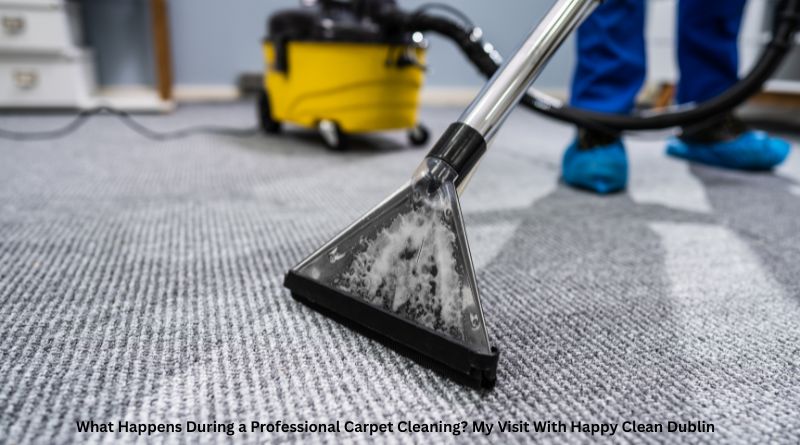
The machine itself produced a steady mechanical hum, deeper and more powerful than a domestic vacuum. When the technician began using the extraction wand, there was a sharp suction sound followed by the rhythmic motion of slow passes across the carpet. Water and cleaning solution were injected into the fibres, then pulled back out along with loosened dirt and residue.
The key word here is slow.
I had imagined a quick sweep over the floor, but each pass was controlled and overlapping. The wand moved in straight lines, then returned over the same area to extract as much moisture and soil as possible. The technique looked almost surgical. Every movement had a purpose.
In high-traffic zones, there were extra passes. Along edges and near furniture lines, the technician paid close attention to buildup that often gets missed. In some rooms, the pile began to lift visibly as the extraction continued. Areas that had looked flat and tired started appearing more even and revived.
The appearance change was gradual but real. The carpet shifted from dull to brighter, from compacted to softer-looking. It didn’t suddenly look brand new in a dramatic, artificial way. It looked restored. Cleaner. More alive.
The technician explained that hot water extraction is effective because it reaches deeper than surface cleaning. Instead of just brushing the top layer, it flushes contaminants from within the pile and removes them through powerful suction. That’s what makes it a genuine, deep carpet-cleaning Dublin solution rather than a cosmetic refresh.
And the sound told its own story. The machine’s low drone, the hiss of solution, the pull of suction, the occasional click of metal attachments against the floor—it all created the sense that something substantial was happening beneath the visible surface.
Drying Process for Carpets
One thing I was especially curious about was drying. A common concern with carpets is that they will stay damp for too long, which can make rooms inconvenient to use and raise worries about smell or residue.
The technicians addressed that straight away.
Because the extraction machine was powerful, it removed a large amount of the moisture during the cleaning itself. The carpet was damp afterwards, but not soaked. That distinction matters. When I touched a cleaned area carefully, it felt cool and slightly moist, not waterlogged.
The team also explained the factors that affect drying time: airflow, room temperature, humidity, carpet thickness, and how heavily soiled the material was to begin with. They advised keeping the room ventilated and avoiding heavy foot traffic until the carpet had fully dried.
At this point, the house smelled noticeably fresher. Not perfumed. Just cleaner. The sort of difference you notice when lingering odours have been lifted away rather than covered up.
Visually, the carpet also had that freshly groomed appearance, with the pile lying in neat directions from the wand passes. It looked cared for. The rooms felt lighter, almost reset.
Final Inspection
The final walkthrough tied the whole experience together.
Instead of packing up and leaving as soon as the machine was switched off, the team inspected the rooms again. They checked the treated areas, reviewed any stains that had needed extra attention, and pointed out the results honestly. Some marks had lifted almost completely. Others had improved significantly but, due to their age or composition, could not be guaranteed to vanish entirely.
I respected that transparency.
The final inspection wasn’t sales-driven or theatrical. It was practical. The technicians wanted to make sure the cleaning had achieved what was realistic, that no areas had been missed, and that I understood what to expect as the carpet dried fully.
This stage also made it clear that a good carpet cleaning service provider in Dublin isn’t just selling machinery. They’re selling judgment. Knowing which stains will respond. Knowing how much moisture to use. Knowing when a carpet needs additional passes and when it doesn’t. Knowing how to protect the fibers while still delivering a visible improvement.
By the end of the visit, the difference was easy to see and even easier to smell. The carpets looked brighter, the rooms felt fresher, and the whole process made much more sense to me than it had before.
What I Took Away From the Experience
Watching the full carpet-cleaning process that Dublin professionals follow completely changed my view. What seems simple from the outside is actually a layered service built around inspection, treatment, extraction, drying, and quality control.
It starts with careful booking. Then comes a purposeful arrival, a close inspection, targeted stain pre-treatment, and the main cleaning using professional-grade hot water extraction. After that, drying guidance and final inspection help make sure the results last.
Most importantly, it’s not just about making a carpet look better for a day. It’s about removing what has settled deep inside it and restoring a cleaner, healthier feel to the room.
After seeing the process from start to finish with Happy Clean Dublin, I understand why professional carpet cleaning in Dublin is treated as a specialist service rather than a simple chore. There’s a lot happening in every pass of the machine.