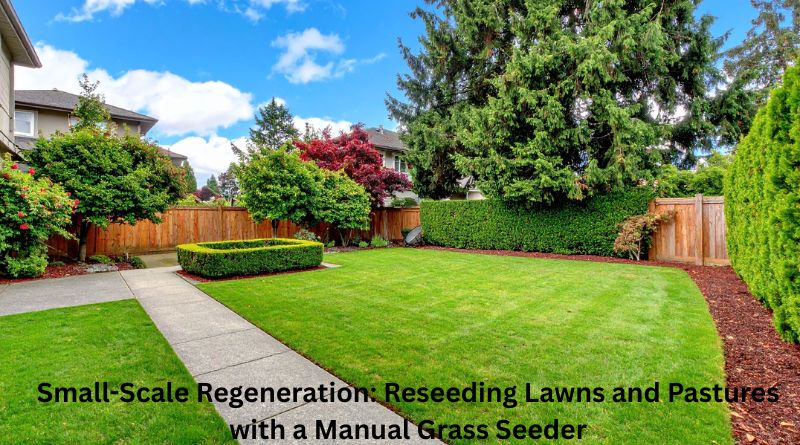
Most sustainability stories focus on big technology. But the quiet revolutions often happen with small, human-powered tools—like a manual grass seeder. Whether you’re turning a strip of lawn into a pollinator corridor or refreshing a tired paddock behind the barn, a compact seeder offers precision, low cost, and a lighter footprint on the soil.
Below, we explore why manual seeders matter, how to choose seed and prepare your site, and the exact steps to calibrate and sow for even, professional results—no tractor required.
Why a Manual Seeder (Still) Beats Broadcast
Uniformity equals establishment. When seeds clump, seedlings compete; when they scatter too thinly, weeds take the invitation. A manual seeder meters flow so you hit the target density across the whole bed or pasture.
Lower costs, lower impact. You avoid fuel, reduce compaction, and often use 10–25% less seed than hand-broadcasting thanks to consistent flow.
Speed with control. Even at walking pace, you’ll cover ground faster than you expect—while staying nimble around trees, beds, irrigation lines, and slopes.
Tool spotlight: The Sembradora de pasto manual is a compact, durable option gardeners and smallholders use for turf, forage, and clover mixes.
For other models or seed sizes, see Agroenlace’s full seeder catalog.
Seed Choice: Match Species to Your Micro-Climate
For low-mow lawns: Fine fescues (chewings, hard, creeping red) build soft, drought-tolerant turf. Add micro-clover for a greener summer and gentle nitrogen fixation.
For mini-meadows & pollinators: Choose regionally adapted mixes with warm- and cool-season species. Blends of ryegrass, fine fescues, and native perennials stagger color and habitat through the year.
For partial shade: Shade-tolerant fescues and woodland perennials handle dappled light and tree root competition.
Pro tip: Tiny seeds prefer shallow placement (about ¼–⅜ in / 0.5–1.0 cm) and a firm, fine seedbed. That’s precisely where manual seeders shine. If you’re new to the process, this friendly walkthrough helps: How to sow grass (step-by-step).
Site Prep in Three Calm Steps
- Mow low & clear thatch. Bag clippings so seeds can meet soil.
- Roughen the surface. Use a rake or light hoe to loosen only the top ½ inch; you’re creating micro-pockets, not tilling.
- (Optional) Top-dress thinly. A ¼–½ inch layer of screened compost/fine topsoil evens moisture and improves contact.
Five-Minute Calibration (That Saves Seed All Season)
Calibration is the difference between “pretty good” and “pro.” Do this once per seed mix:
- Add a known weight (e.g., 2 lb / 1 kg) to the hopper.
- Set the smallest opening and walk a test strip (50–100 ft / 15–30 m) at your natural pace.
- Weigh the output and scale to your area and desired rate (kg/ha or lb/ac).
- Nudge the gate one click at a time until the math matches your target.
- Confirm with a plot test: seed a marked 100 m² area and re-check the remainder.
Seeding Technique: Smooth, Overlapped, and Perpendicular
- Walk straight, parallel lines with a steady pace.
- Aim for 10–15% overlap to avoid striping.
- For ultra-even coverage, add a second pass perpendicular to the first.
- On slopes, seed along contours to slow water and keep seed in place.
Finish: Lightly rake to whisper a veil of soil over the seed, then firm the surface (a lawn roller is nice; walking with soft-soled shoes works too).
Watering & Aftercare
Germination window: Keep the top ½ inch evenly moist until you see sprouts.
- Week 1–2: Daily light mistings (or rely on steady rain).
- Week 3–4: Every other day, slightly deeper to train roots.
- After establishment: Transition to less frequent, deeper watering.
First trim: Wait until growth reaches 3–4 in (7–10 cm). Mow high and gentle; think root training, not golf-course stripes.
Design Ideas for a Magazine-Worthy Finish
- Pollinator ribbon: Turn a 2–3 ft border into a native meadow path with stepping stones.
- Orchard understory: Low, soft blends under fruit trees—green mulch that welcomes beneficials.
- Slope saver: Deep-rooted natives tame erosion and look gorgeous waving in evening light.
- Pasture patching: Interseed thin spots after grazing to keep forage dense and resilient.
Troubleshooting (Quick Fixes)
- Stripey pattern: Increase overlap or add a perpendicular pass.
- Bridging in the hopper: Gently tap the side; an internal agitator helps on humid days.
- Patchy germination: Re-mist daily, top-dress lightly with screened compost, and protect from foot traffic.
- Moss or thatch issues: Scarify lightly before seeding; improve airflow and sun exposure.
Sustainability & ROI (Why This Pays for Itself)
- Seed savings: Consistent metering can cut use by 10–25% vs. broadcast.
- Fewer do-overs: Even stands out-compete weeds, so you resow less.
- No fuel, minimal maintenance: Human power + simple cleaning after use.
- Healthier soil: Less compaction means better infiltration, microbial life, and resilience.
If you’ll handle multiple species or larger areas over time, consider pairing your manual unit with other formats. Agroenlace’s seeder range shows models designed for different seed sizes and workflows.
Print-Friendly Checklist
- ☐ Mow low; remove thatch/clippings
- Lightly roughen top ½ inch of soil
- (Optional) Thin compost/topsoil dressing
- Calibrate seeder (bench test + 100 m² plot)
- Seed with 10–15% overlap; add a perpendicular pass
- Light rake + firm surface
- Keep surface evenly moist 10–14 days
- ☐ First trim at 3–4 inches (high setting)
FAQs
Can a manual seeder handle micro-clover or wildflower blends?
Yes. Start with the lowest effective setting and make two light passes for balance.
How deep should I place seed?
For small grass/legume seeds, ¼–⅜ in (0.5–1.0 cm). Deeper than that reduces emergence sharply.
Is fall or spring better for seeding?
Both work. Late summer/early fall is excellent in many regions (warm soil, softer sun). Spring is great for cool-season grasses once frost danger passes.
Do I need to roll?
Rolling is optional. Gentle firming—even foot-tamping—usually provides enough seed-soil contact.